0:00
US Dominance: Core Tech, Talent, and Capital Investment
Welcome to the debate.
By the year 2030, you know the superpower that controls artificial intelligence will effectively control the global economy.
0:09
Speaker 2
Yeah, absolutely.
There's really no question about that anymore.
0:12
Speaker 1
Right.
But the winner of this race isn't going to be decided by like, elegant equations on a chalkboard in Silicon Valley.
It's going to be decided by concrete, copper wire and zoning laws.
0:24
Speaker 2
It's a massive conceptual shift.
I mean, we all love the romance of the pristine laboratory.
It's clean.
It's intellectual.
0:32
Speaker 1
Very sci-fi.
0:33
Speaker 2
Exactly.
But when you step out of the lab to actually build this future, that romantic image just shatters.
You're suddenly talking about securing gigawatts of power, navigating industrial supply chains and, you know, pouring millions of tons of concrete.
0:48
Yeah.
0:49
Speaker 1
And that messy physical reality is exactly where we find ourselves today.
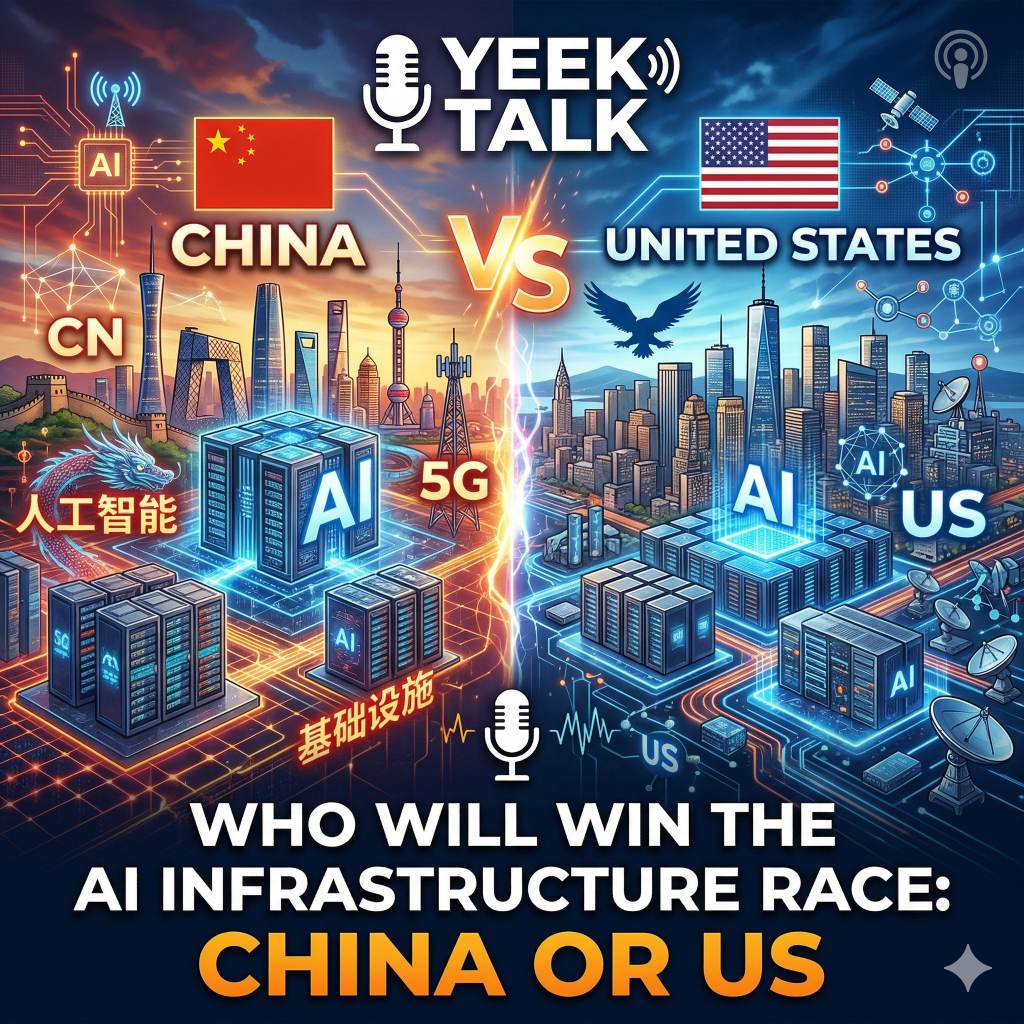
So as we sit here in March 2026, we are examining a central defining question which superpower will ultimately win the AI competition, the United States or China?
1:07
Speaker 2
It's the biggest question of our decade.
1:09
Speaker 1
It really is, and I represent the view that the United States will definitively win this race due to our unparalleled technical foundations, our superior foundation models, and the massive capital investment driving us toward artificial general intelligence.
1:25
Speaker 2
And I hold the opposing view.
China will ultimately win because their approach recognizes this is no longer a science project, but a massive industrial roll out defined by rapid physical deployment, unmatched data scale, and a highly agile regulatory environment.
1:39
Speaker 1
Well, let's get right into it then.
To understand why the US has the upper hand, I mean you really have to look at the structural bedrock of the technology we control, the hardcore foundations.
1:51
Speaker 2
You mean the hardware?
1:52
Speaker 1
The hardware, the talent, all of it.
That means the absolute top tier silicon, the raw compute power, and the core algorithmic architecture.
2:01
Speaker 2
If you look at the tech giants, you know, NVIDIA, Open AI, Google, they are consistently maintaining a three to six month lead in frontier model capabilities.
2:12
Speaker 1
Yeah, but in the tech world, a six month lead is practically an eternity.
2:18
Speaker 2
Exactly it compounds.
And fueling that compounding lead is a staggering sixty $500 billion of investment, 6 1/2 trillion dollars explicitly dedicated to achieving AGI.
2:29
Speaker 1
That is a lot of capital.
It's unprecedented.
And that capital isn't scattered right?
It's a heavily focused Sprint.
Plus we have the geopolitical leverage of export controls.
We effectively restrict China's access to the absolute latest, most capable GPU's.
2:47
We control the spigot of the underlying hardware that makes advanced AI possible.
2:51
China's Advantage: Rapid Deployment and Flexible Regulation
But controlling that specific hardware spigot relies on a metric of success that I think is, well, it's already outdated.
3:00
Speaker 1
How so?
3:01
Speaker 2
You're talking about frontier laboratory models, but the nature of the race has fundamentally shifted.
It's not about who has the smartest theoretical model in a vacuum.
It's about physical economic deployment, right?
3:14
Speaker 1
But you still need the frontier models to actually power the economy.
I mean, if your model hallucinates it's or just can't reason the economic deployment fails.
3:23
Speaker 2
It's models in downloads on Hugging Face.
3:25
Speaker 1
Really surpassing.
3:27
Speaker 2
Yes, and it's driven entirely by unmatched cost effectiveness.
The raw metrics from last month, February 2026, are incredibly telling here.
China's AI token call volume was double that of the US.
3:41
Speaker 1
OK, wait, let's breakdown that metric though.
A token call just means the model generated a piece of text or data, right?
But what are those tokens actually doing?
Are they writing novel pharmaceutical compounds?
Or are they just, you know, generating low level customer service chat bots?
3:59
Volume doesn't always equal value.
4:01
Speaker 2
It represents actual utilization in the real world, regardless of the tasks prestige.
Every single token call is a microtransaction of compute that familiarizes an entire industry.
With AI integration.
They are building operational muscle memory.
4:16
Chinese firms now occupy 4 of the top five global spots in that metric.
Through their AI Plus initiative, they are aggressively deploying these systems directly into the physical economy.
4:27
Speaker 1
Like where?
4:28
Speaker 2
We're talking about optimizing logistics in deep water ports, automating quality control and massive factories, and managing safety sensors in coal mines.
They are literally wiring a nervous system into their entire industrial base.
They are moving from a Sprint for AGI to building a sprawling, lucrative AI highway.
4:45
Speaker 1
OK, I see what you're saying about deployment, but you can't just decouple that physical rollout from the rules governing it.
The friction we're seeing in the US isn't a lack of ambition to build an AI highway.
It's a rigorous regulatory environment ensuring that highway doesn't collapse.
5:00
Speaker 2
I come at it from a different way.
That regulatory friction is exactly why China is accelerating past the US The speed of integration is dictated almost entirely by the legal environment, and China's primary advantage right now is a relatively frictionless ecosystem characterized by flexible guidance.
5:18
Speaker 1
So basically deploy first, regulate later.
5:21
Speaker 2
Exactly.
Board the train first, buy the ticket later.
If a company wants to integrate a vision model into a manufacturing arm in Shenzhen, they just do it.
Contrast that with the United States.
We are acting like what I would call a loyal builder.
5:35
Speaker 1
A loyal builder.
5:36
Speaker 2
Yeah, we desperately want to build the skyscraper, but every single brick has to pass through environmental reviews, union negotiations, and antitrust scrutiny.
Look at the absolute market shock.
A few days ago, on March 25th, Bernie Sanders and AOC proposed the AI Data Center Moratorium Act.
5:58
Speaker 1
Right, which seeks to halt all new AI data center struction over climate and grid concerns.
6:04
Speaker 2
Exactly, and tech stocks plummeted 3 to 5% in a single day because of it.
Think about the mechanics of a moratorium.
It doesn't just pause a building, it freezes the entire supply chain.
6:17
Speaker 1
It definitely causes a shock.
6:19
Speaker 2
A massive 1 contractors are let go, chip orders are cancelled and you lose your place in the power grid interconnection queue, which by the way, can take years to get back.
When your legal framework actively threatens to pull the plug on your physical infrastructure, you simply cannot win an execution race.
6:37
US Pressure Cooker vs. China's House of Cards
I'm not convinced by that line of reasoning, because you're treating rapid deployment without guardrails as a pure, unalloyed advantage.
I fundamentally reject that premise.
6:48
Speaker 2
Why speed is everything right now?
6:51
Speaker 1
Because speed isn't everything if the foundation is rotten.
Yes, the US regulatory environment is rigorous.
Yes, the Moratorium Act cost a market shock because it introduces friction.
But think of the US environment as a pressure cooker.
7:04
Speaker 2
A pressure cooker that might explode its own supply chain.
7:09
Speaker 1
No.
A pressure cooker that forces the creation of universally trusted, highly optimized systems.
The strict rules, the intense public scrutiny, the environmental standards.
These constraints are a gauntlet.
When a U.S. company finally deploys an AI system globally, the market knows it has survived that gauntlet.
7:28
Speaker 2
OK, but.
7:29
Speaker 1
It won't blow up in their faces.
China's board first, buy the ticket later approach is structurally fragile in this industry.
A single catastrophic failure, say a massive autonomous systems error in a major automated port or a severe corporate data breach, could instantly vaporize international investment and global trust.
7:51
Speed is utterly useless if you build a House of Cards.
7:55
Speaker 2
But calling it a House of Cards implies the structure itself is weak.
The infrastructure China is building is highly resilient precisely because it's being stress tested in reality, not in a committee hearing.
8:07
Speaker 1
Stress testing in public is risky.
8:09
Speaker 2
But it works.
By putting AI into a working coal mine, they are finding the mechanical edge cases of industrial automation Today.
They are solving real world latency and hardware integration problems while U.S. companies are literally still filling out environmental impact reports for the server farm.
8:25
Speaker 1
Sure, but.
8:26
Speaker 2
The flexible guidance model allows for rapid iteration.
If something breaks, the state steps in, corrects the course, and the ecosystem moves forward.
The US Loyal builder approach means we are theoretically perfecting systems that will be economically obsolete by the time they are legally permitted to launch.
8:43
Powering AI: Terrestrial Grids and Orbital Compute
OK, but even if we completely deregulated tomorrow, the US still hits a brick wall that no amount of policy can fix.
We simply don't have the electricity to turn these machines on.
8:54
Speaker 2
Ah, energy.
And this is where the dynamic really shifts.
The US is essentially trying to power a bullet train using a network of a A batteries.
9:03
Speaker 1
That's that's a grim way to put it.
9:05
Speaker 2
It's true though.
We have the fastest algorithms, but our legacy grid is fundamentally mismatched to the load.
Training these massive trillion parameter foundation models requires A staggering amount of uninterrupted base load electricity, and the US power grid is notoriously aging.
9:22
Speaker 1
We definitely have great issues.
9:24
Speaker 2
We've seen summer blackouts in California and Texas that have already forced companies like NVIDIA and Google to halt or significantly delay major compute projects.
You cannot train AGI when your data center goes dark every August.
9:37
Speaker 1
Yeah, the base load problem is very real.
I mean, the cooling requirements alone for a massive GPU cluster are astronomical.
Terrestrial cooling requires massive chillers, water evaporation towers.
It's a huge parasitic load on the grid.
9:50
Speaker 2
Exactly.
Now contrast that with China's state backed energy grid.
They are heavily utilizing hydro, nuclear and wind power to provide highly stable electricity at rates between 0.3 and 0.5 RMB per kWh.
10:04
Speaker 1
Wow, so that's.
10:05
Speaker 2
That is roughly half the US cost, and local governments and tech hubs, you know, Shenzhen, Shanghai, Hangzhou are actively subsidizing that power to guarantee rapid AI cluster expansion.
It's an endless supply of cheap, reliable energy specifically routed to support AI infrastructure.
10:25
Speaker 1
I see why you think that, but let me give you a different perspective.
You're assuming the United States is permanently trapped by terrestrial legacy grid limitations.
But US innovation doesn't just accept physical bottlenecks.
We engineer our way out of them.
10:42
Consider the space domain.
10:44
Speaker 2
Wait, are you seriously suggesting we bypass the US power grid by launching servers into low earth orbit?
10:50
Speaker 1
Yes, absolutely.
SpaceX recently filed an FCC application for exactly this.
We are talking about launching millions of satellites equipped with terrafab AI chips and giant solar arrays.
11:04
Speaker 2
Millions of satellites.
11:06
Speaker 1
Yes, the explicit goal is to completely bypass the Earth's power grid by 2028 or 2029, and the physics of this are brilliant.
By putting the compute in space, you have 0 cloud cover, meaning uninterrupted solar.
11:21
Speaker 2
Power.
OK, but.
11:22
Speaker 1
More importantly, you utilize the vacuum of space for free cooling.
For terrestrial data centers, chilling the water to keep the GPU's from melting accounts for a massive percentage of the energy draw.
In space, that thermal management bottleneck virtually disappears because space acts as an infinite heat sink.
11:40
The Terafab architecture is designed specifically for this thermal environment.
This isn't science fiction, it is a heavily capitalized active engineering project to literally transcend the terrestrial energy problem.
I'm.
11:53
Speaker 2
Sorry, but I just don't buy that.
Let me tell you why.
The SpaceX orbital plan is economically extreme and technologically highly speculative for a 2028 timeline.
12:03
Speaker 1
It's ambitious, sure.
12:04
Speaker 2
It's more than ambitious.
Yes, vacuum cooling is thermodynamically great, but how do you solve the latency?
You were talking about beaming petabytes of training data up and down through the atmosphere.
The speed of light is fast, but atmospheric interference and orbital distances introduce latency that makes real time inference incredibly difficult.
12:26
Speaker 1
Well, you wouldn't use it for real time.
12:28
Speaker 2
And furthermore, how do you shield delicate Terafab GPU's from cosmic radiation?
A single flipped bit from a solar flare can ruin a multimillion dollar training run, and the economics of repairing a dead server in low Earth orbit are just disastrous.
12:43
Speaker 1
OK, but the Tarafad chips incorporate physical radiation hardening and like I was going to say, the latency is manageable for asynchronous training runs rather than real time inference.
12:55
Speaker 2
Even if they solve the hardware degradation, China is already moving aggressively into orbital compute, but with state backing rather than just private venture capital.
Look at China's Tian Huang project.
13:07
Speaker 1
Right.
I've seen the briefs on that.
13:09
Speaker 2
They aim to launch 1000 orbital data centers by 20-30.
They haven't just filed paperwork, they've already actively tested AI chips on the Tiangong space station and they demonstrated a 30% increase in training efficiency utilizing that exact vacuum environment you're talking about.
13:27
So even if the US attempts an orbital escape from its grid problems, China is right there with them, leveraging the exact same vacuum cooling but integrating it into a broader state-run infrastructure plan.
13:38
US Compute Colonies vs. China's Data Advantage
Well, if the physical and regulatory roadblocks in the continental US are as severe as the Moratorium Act suggests, the US doesn't have to rely purely on domestic infrastructure, and we don't have to wait for orbital servers to become economically viable either.
13:53
Speaker 2
What's the alternative?
13:55
Speaker 1
The United States has a massive structural advantage in its global alliances.
We can utilize places like Canada or Australia to build what are essentially compute colonies.
14:06
Speaker 2
Ah, exporting the server farms.
14:08
Speaker 1
Exactly.
We offshore the massive energy intensive compute needs to friendly nations with vast natural resources.
We let them handle the power generation and the concrete pouring, but we retain the core intellectual property, the elite talent, and the algorithm dominance right here at home.
14:24
We leverage our geopolitical network to solve the physical bottleneck without sacrificing our technical lead.
14:30
Speaker 2
That's a compelling theory, but it's shatters upon contact with current geopolitical and physical realities.
The idea of compute colonies assumes that sovereign nations want to sacrifice their own energy security to power American AI.
14:45
Speaker 1
They want the investment though.
14:47
Speaker 2
Let's look at Canada.
Quebec has incredible hydroelectric resources, but they've explicitly stated they are prioritizing winter heating for their citizens, overpowering USAI clusters.
You simply cannot explain to a voter in Montreal that their heating bill is spiking so a tech giant in Silicon Valley can train a foundation model.
15:06
Speaker 1
But the economic incentive to host the infrastructure of the next technological revolution is immense.
It brings massive capital investment to their local economies.
15:16
Speaker 2
It brings capital, but not necessarily jobs.
Cross-border data centers are facing severe local push back precisely because data centers don't employ many people once they are built.
They just sit there draining the grid and generating carbon emissions.
15:30
Speaker 1
That's a fairpoint on the jobs front.
15:32
Speaker 2
And this friction is completely exacerbated by recent US tariff disputes.
The alliance strategy is struggling because allies have their own national interests.
Now contrast that fragmented strategy with China's deeply integrated internal momentum.
15:47
Speaker 1
They don't have the same alliance network though.
15:50
Speaker 2
They don't need to beg allies for power or data.
They have an internal ecosystem of 1.4 billion users, generating roughly 10 times the raw training data of the US.
16:02
Speaker 1
OK, but data volume isn't everything though.
16:05
Speaker 2
US dropped to 25%.
They are turning that massive data advantage and internal infrastructure into legally protected intellectual property at a vastly faster rate than the USI.
16:17
Speaker 1
Have to challenge the utility of that patent metric though.
A massive volume of patents does not equate to foundational scientific breakthroughs.
Often what you're seeing in those numbers are minor iterative tweaks on existing open source architectures.
16:32
Speaker 2
Iteration is how you improve the physical product.
16:35
Speaker 1
But the United States maintains its 25% by focusing on paradigm shifting innovations, the zero to 1 breakthroughs that actually redefine what the technology can do.
And regarding the data advantage, the utility of raw human generated data is hitting a plateau.
16:52
We are quite literally running out of the Internet to scrape.
16:56
Speaker 2
Which is a problem for both sides.
16:58
Speaker 1
But it hurts the US less because the next frontier of model training relies on synthetic data and algorithmic efficiency.
Synthetic data isn't just more data.
It's where an advanced AI generates highly curated, perfectly labeled logic pathways to teach the next generation of AI right.
17:16
It trains models to reason rather than just regurgitating human text.
It completely bypasses the need for 1.4 billion human users.
Tapping on smartphones and generating that synthetic data requires the absolute peak of core algorithmic talent, an area where the US is demonstrably unmatched.
17:36
Speaker 2
Synthetic data is absolutely vital, but how do you generate it?
It still requires massive compute, bringing us right back to the energy and infrastructure bottleneck.
You need electricity to run the models that generate the synthetic data.
17:50
Speaker 1
True, you do need the compute.
17:52
Speaker 2
And furthermore, the data China is collecting isn't just people chatting on social media.
It's high fidelity industrial data.
It's the telemetry from millions of autonomous vehicles navigating complex city streets.
It's the operational data from automated ports.
It's the efficiency metrics from robotic factory floors.
18:10
Speaker 1
It's very specialized.
18:12
Speaker 2
Exactly.
That is the specialized data that builds A dominant economic system, and you cannot synthesize the physical chaos of the real world.
18:20
The Defining Clash of AI Philosophies and Infrastructure
Mm.
Hmm.
18:24
Speaker 1
It builds a highly efficient industrial system, I'll grant you that, but it doesn't necessarily build artificial general intelligence, and that is where I anchor my position.
I firmly believe the United States will ultimately prevail in this competition because technological revolutions of this magnitude are won by fundamental scientific breakthroughs and absolute model superiority. the US possesses an ecosystem of elite talent, institutional knowledge, and deep capital that is uniquely capable of pushing the frontier of physics and computer science.
18:59
Whether it's developing entirely new neural architectures, engineering the next generation of semiconductors, or literally launching our compute infrastructure into orbit to bypass the grid, the US innovation engine remains unmatched.
We may face regulatory friction and power constraints, but our capacity to invent our way out of those constraints is the defining characteristic of our technological history.
19:20
Speaker 2
And I maintain that the lens through which you are viewing this competition is flawed.
AI is no longer a purely academic exercise, it is a brutal, physical, industrial one.
The winner will not be the one who possesses a slightly smarter model locked in a laboratory.
19:36
Well, the winner will be the one who successfully rewires their entire economy with this technology.
China's combination of massive state directed energy infrastructure, a frictionless regulatory environment that encourages rapid deployment, and an unmatched real world industrial data loop is creating an insurmountable lead.
19:55
They are not waiting for perfect AGI.
They are using highly capable, cost effective models to optimize their physical world today.
Within the next five years, this momentum will solidify China's AI economy in a way that the US, burdened by systemic grid issues and regulatory gridlock, will simply not be able to match.
20:13
Speaker 1
You know, despite our deep disagreements on the ultimate victor, it's clear we have significant points of convergence here.
We both recognize that the next two to five years represent a critical defining window for this technology.
The decisions made between now and 2030 will set the trajectory for the rest of the century.
20:32
Speaker 2
Oh, absolutely.
And we both completely agree that raw electrical power, you know the hard physical constraint of energy generation, is the defining bottleneck of the AIH.
It's deeply fascinating how a debate about the most advanced software humanity has ever created ultimately comes down to Transformers, power lines and cooling systems.
20:51
Speaker 1
It forces us to view this not just as a technology race, but as a fundamental clash of physical infrastructure and regulatory philosophies.
It is the friction of the real world pushing back against the boundless ambition of software.
21:07
There is incredibly deep complexity here in how these two distinctly different ecosystems will evolve.
The US with its pressure cooker of regulation and high capital innovation against China's rapid industrial integration and state backed infrastructure.
21:23
Speaker 2
It is a profound structural divergent.
21:25
Speaker 1
Which leaves us right where we started.
When you look past the romance of the laboratory, past the equations on the chalkboard, you are left with the massive, messy reality of pouring the concrete for the future.
We leave it to you to draw your own conclusions on who will ultimately lay that foundation fastest and cross the finish line first.
Who is going to win the AI Infrastructure Race - US vs China