How AI Music Generation Works — And Why It’s So Controversial
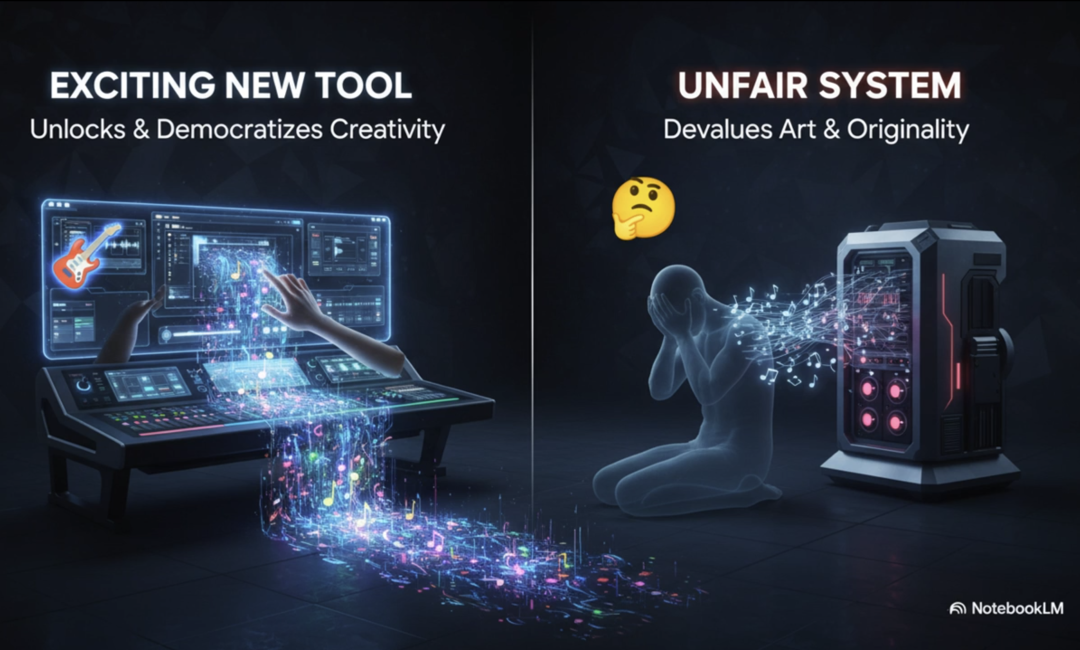
Artificial Intelligence is transforming music creation in a way we’ve never seen before. For some, it’s an exciting new tool that unlocks creativity. For others, it raises serious concerns about originality, ownership, and fairness.
To understand both sides, we need to look at two things:
- How AI music models are actually trained
- Why many people believe this process crosses a line
1. Music Is Structured — But Not Just Rules
Music has strong patterns:
- Rhythm follows timing structures
- Harmony follows chord relationships
- Melodies often stay within scales
These ideas come from Music Theory and connect closely to Mathematics.
Because of this, it’s true that music can be analyzed in a structured, almost mathematical way.
But music is more than rules. Great songs often bend or break those rules. Emotion, culture, and personal experience all play a huge role—things AI doesn’t truly possess.
2. How AI Actually Learns Music
AI music systems are trained using techniques from Machine Learning.
They are fed large datasets such as:
- MIDI files (notes, timing, instruments)
- Audio recordings
- Symbolic representations of music
Using Neural Networks, the AI learns patterns like:
- Which notes tend to follow others
- Common chord progressions
- Rhythmic and stylistic structures
Importantly, the model doesn’t store songs like a library.
Instead, it learns probabilities and relationships between musical elements.
3. How AI Generates Music
When creating music, the AI:
- Starts with a prompt (style, mood, or melody)
- Predicts the next note or sound
- Repeats this step to build a full piece
This is similar to how systems like GPT (Generative Pre-trained Transformer) generate sentences—just applied to sound instead of words.
Because it works on probabilities, AI can generate:
- Endless variations
- New combinations
- Music at massive scale
4. A Common Misconception: “Trying Billions and Checking”
A natural assumption is that AI:
Generates tons of music and checks each one against existing songs
In reality, that’s not how it works.
Instead, the model improves itself during training by minimizing errors using methods like Gradient Descent.
It’s not brute-force trial and error—it’s continuous learning and adjustment.
5. The Role of Human Feedback
Some systems also use human input to improve results through Reinforcement Learning.
For example:
- Listeners rate outputs
- Better results are reinforced
- Poor results are reduced
This helps AI produce music that feels more natural or emotionally appealing.
6. The Core Concern: Is AI Just Copying?
Now to the heart of the controversy.
Many critics believe AI music is:
- Copying human-created work
- Remixing existing songs
- Benefiting from artists without permission
And this concern doesn’t come from nowhere.
AI models are trained on large amounts of human-created music. Without that data, they wouldn’t be able to learn.
So the question becomes:
Is learning from music the same as copying it?
7. What AI Is (and Isn’t) Doing
What AI is doing:
- Learning patterns, styles, and structures
- Generating new sequences based on probability
What AI is not typically doing:
- Storing full songs and replaying them
- Intentionally copying a specific track
A useful comparison:
- Human musicians also learn by listening to others
- Over time, they develop their own style
AI does something similar—but:
- At a massive scale
- Without personal experience or intent
8. Where the Concerns Are Valid
Even if AI isn’t literally copying, there are real issues:
1. Style imitation
AI can closely mimic specific artists, raising questions about identity and originality.
2. Training data transparency
It’s often unclear what music was used in training.
3. Compensation
Artists may not be paid, even if their work helped train the model.
4. Economic impact
AI could reduce demand for certain types of music work.
These are legitimate concerns—not misunderstandings.
9. A Technology Ahead of Its Rules
Laws and regulations haven’t caught up yet.
Open questions include:
- Should artists have to consent to training use?
- Should they be compensated?
- Who owns AI-generated music?
There is no global consensus yet, and different regions are approaching this differently.
10. A Balanced Perspective
Both sides of the debate have valid points:
Pro-AI view:
- AI democratizes music creation
- Anyone can turn ideas and emotions into songs
- It expands creativity and access
Concerned view:
- AI relies heavily on human-created work
- It may blur the line of originality
- It raises fairness and ownership issues
These are not mutually exclusive truths—they coexist.
Final Thought
AI music generation is not simply “magic,” and it’s not simply “theft” either.
It is a powerful tool built on human creativity, capable of scaling it in ways never before possible.
The real challenge is not whether AI should exist—it already does.
The challenge is:
How do we shape it so innovation continues, while still respecting the people whose creativity made it possible?
That’s the question that will define the future of music.